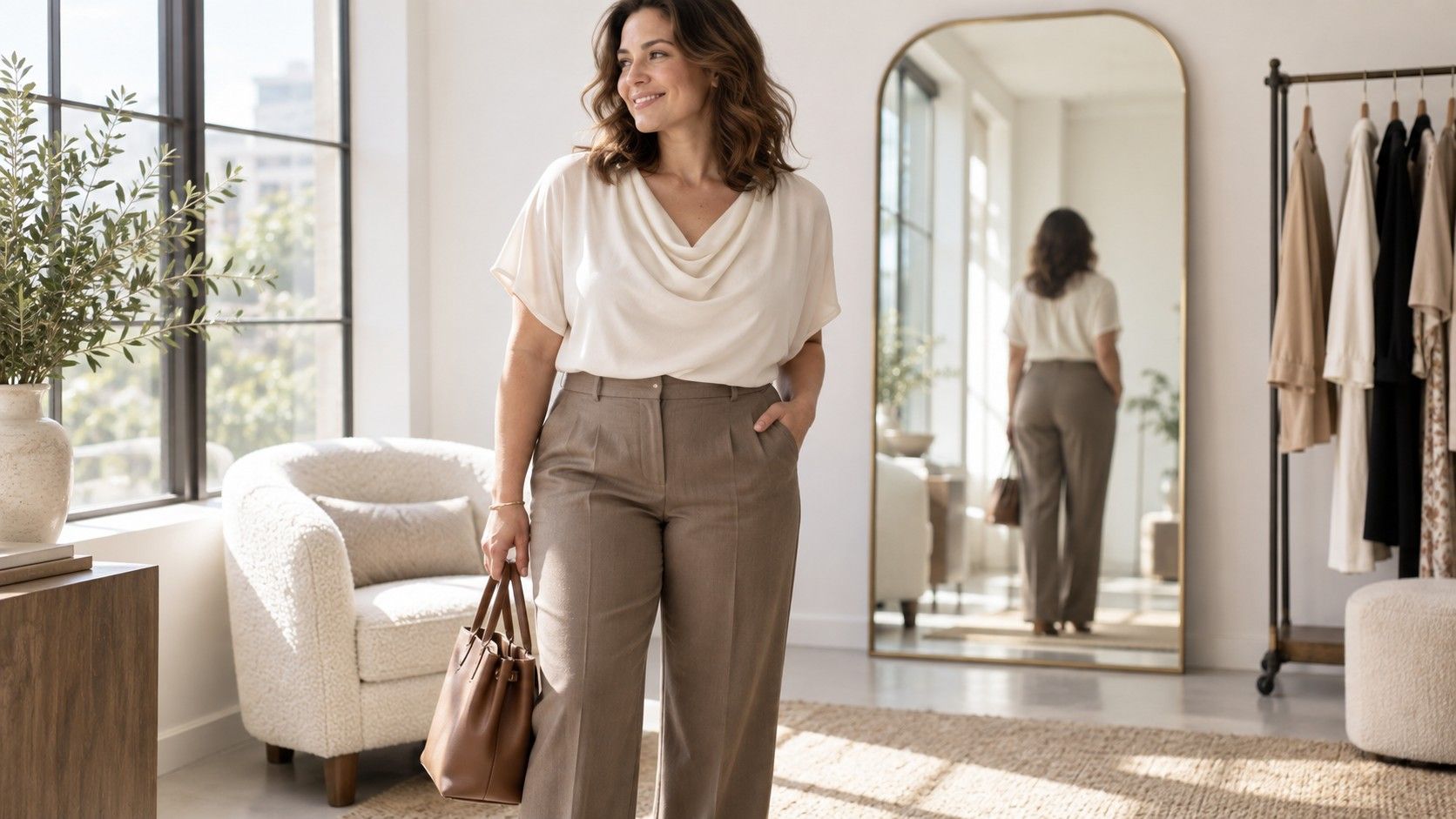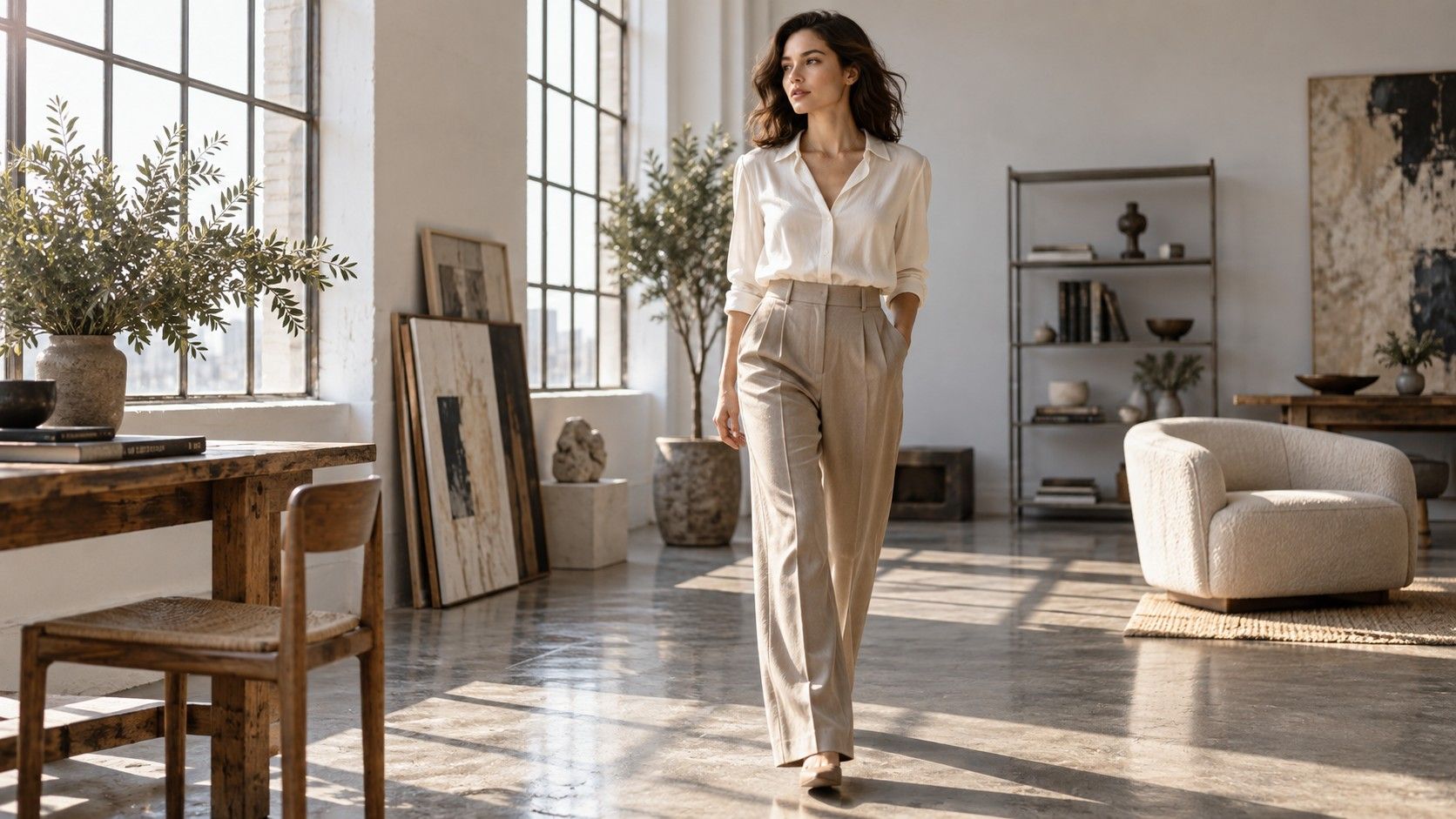
A short torso and long legs are not a problem to solve; they are simply a proportion that makes certain ready-to-wear cuts feel oddly abrupt. A high waist can seem to arrive under the ribs, a tucked shirt can leave very little space between bust and waistband, and a tiny jacket can make the upper body feel compressed. The useful goal is not to disguise long legs. It is to give the torso a little breathing room while keeping an outfit easy to move in.
First, check the proportion rather than guessing from your height
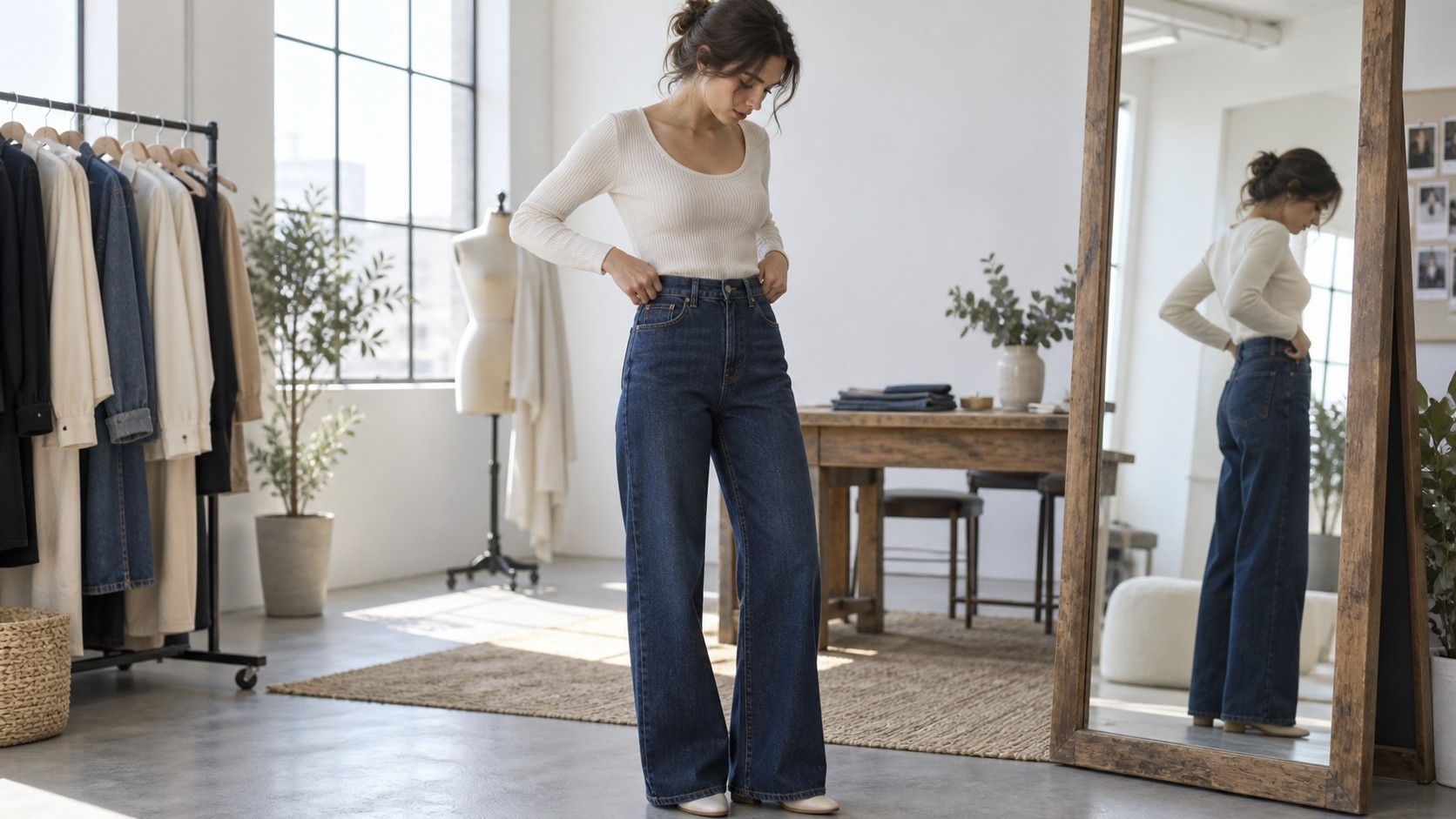
Stand in front of a full-length mirror in fitted leggings or jeans and a simple top. Notice where your natural waist sits in relation to the lowest part of your ribcage and the top of your hips. People with a short torso often have a compact space there, while the hip-to-floor line looks long. This can be true at any height and at any clothing size.
Choose trouser rises for space, not for a rule
Use a phone photo as a second check. Mirrors can be misleading when the camera is low, the room is narrow, or you are standing with one knee bent. Take a straight-on photo from about waist height, then compare a top tucked in and worn loose. The difference usually makes more sense than a body-shape label ever will.
Use top length to create a gentle visual break
Fit also matters. A waistband that is too tight rides upward and creates a short-torso effect on almost anyone. Before changing your whole wardrobe, make sure the garment is sitting where it was designed to sit rather than being pulled toward the narrowest point of your body.
Very high-rise trousers are popular because they can feel secure and polished, but they are not automatically the most balanced choice for long legs. If the waistband reaches the bottom of your bra band, it can erase the small amount of visible torso you have. A comfortable mid-rise often gives more room between the bust and waist without making the legs look any less elegant.
That does not mean high rise is forbidden. Look for a rise that reaches the natural waist instead of climbing above it, and pay attention to the front length when you sit. A soft denim waistband or a trouser with a shaped, slightly lowered front can be much easier than a rigid pair that presses into the ribs all afternoon.
| Rise choice | What it tends to do | Useful try-on check |
|---|---|---|
| Low rise | Adds visible torso length but may feel insecure or cut across the hips | Sit down and make sure the back stays covered |
| Mid-rise | Usually creates a relaxed, even division between torso and legs | Check that the waistband does not roll or pinch |
| Natural high rise | Defines the waist without crowding the ribcage | Raise both arms; the waist should stay put |
| Extra-high rise | Can look intentional with a short top, but may compress the upper body | Look at a side photo as well as the mirror |
Inseam changes the picture too. A cropped ankle length puts another horizontal break on an already long leg, while a full-length straight or gently wide leg creates one clean line. Neither is wrong. The deciding question is whether you want the outfit to feel playful and segmented or calm and elongated.
The easiest short torso styling adjustment is often the hem of the top. A top that ends exactly at the waistband can make the upper half look like one small block. Try a hem that falls one or two inches below the waistband, or a shirt with a rounded hem that reveals the hip gradually. That small overlap softens the boundary without hiding the waist entirely.
Full tucks are worth treating as an option, not a uniform. A half-tuck, a French tuck, or a thin knit lightly bloused over the waistband can give definition while preserving vertical space. With a button-down, leave a little ease through the body rather than pulling it flat across the stomach. The goal is a line with air in it, not a diagram of where every inch of torso begins and ends.
Necklines help as well. A V-neck, open collar, scoop neck, or vertical button placket draws the eye through the upper body. This is especially useful when the outfit already has a strong waist seam. A crew neck can still work beautifully, but pairing it with a long pendant, an open cardigan, or a visible shirt placket may stop the upper half from feeling boxed in.
Let jackets and layers start lower than you expect
A cropped jacket can be excellent if it ends near the high hip instead of directly under the bust. The version that feels difficult is the sharply shrunken blazer or denim jacket whose hem meets the waistband at the shortest possible point. It doubles the horizontal line and can make the torso look even more compact.
Try an unbuttoned blazer that reaches the high hip, a cardigan that skims the upper thigh, or a vest with a longer front. The open vertical edges are often more important than the exact length. When you walk, they create movement through the torso instead of placing a hard lid over it.
Pay attention to shoulder structure. Large shoulder pads plus a tiny cropped length can turn a small torso into a rectangle. A softer shoulder, a raglan sleeve, or a lightly defined waist usually feels less severe. If you love a cropped layer, wear it over a slightly longer tee or tank so the two hems do not land in precisely the same place.
Pick dresses by waist placement and fabric behavior
Dresses remove the question of matching top and trouser rises, but the waist seam becomes even more important. An empire seam sitting high under the bust can shorten the torso further unless the bodice has enough length and drape. A drop-waist dress, a shirt dress with an adjustable tie, or a wrap dress with its waist placed at your natural waist can feel more relaxed.
Belts are useful when they are chosen with restraint. A narrow belt in a similar colour to the dress creates definition without cutting the body into two obvious halves. A wide, contrasting belt can be striking, but it also announces the waistline. Test it from the front and side before deciding it is the reason a dress feels wrong.
For skirts, a mid-rise A-line shape often gives the torso a little more visible length than a very high paperbag waist. A column skirt can work with a soft untucked knit, while a slip skirt looks balanced with a top that skims rather than stops sharply at the waistband. Fabric matters: stiff waistbands make proportion decisions louder; fluid fabrics let them recede.
Use colour and shoes without shrinking the upper half
Matching shoes to trousers or tights keeps the leg line continuous, which is easy to do when you already have long legs. If you would rather make the torso feel longer, introduce interest above the waist instead: a lighter shirt under a darker jacket, a scarf worn open, or a textured knit. The point is not to make the legs disappear but to give the eye somewhere else to travel.
Strong contrast at the waist is the detail most likely to make the body feel divided. A black belt over a pale dress, a white tucked tee over dark high-rise jeans, and a very short jacket can all stack the same message. Break up one of those elements: choose a lower-contrast belt, let the tee blouse out, or replace the jacket with an open layer.
Heels are optional, not a proportion requirement. Flat loafers, trainers, ankle boots, and sandals can all look considered when their weight suits the trouser hem. A chunky shoe with a very narrow cropped pant may create more visual stops than you want; a straighter hem or a slimmer shoe often settles the outfit without changing your body at all.
A fitting-room routine that prevents overcorrection
Bring two rises, two top lengths, and one layer into the fitting room. Start with the pieces that are most comfortable, then photograph each combination from the front, side, and a few steps back. Do not judge only while standing still. Sit, bend, lift your arms, and walk toward the mirror. A proportion trick that needs constant tugging is not a good outfit.
Look for one clear intention rather than trying to lengthen, shorten, define, and smooth every area at once. Perhaps the trousers sit at a relaxed mid-rise and the shirt has an open collar. Perhaps the waist is high but the cardigan is long and open. Those choices feel more personal than following a rigid list of do's and don'ts.
When an outfit feels off, identify the exact interruption: is the waistband too high, the top too short, the jacket too boxy, or the belt too contrasting? Change one piece and check again. That small, practical approach is the most reliable way to dress a short torso and long legs with comfort and confidence.