The best jeans for your body shape are usually the pair that fits your waist, hips and movement first, then gives you the silhouette you actually enjoy wearing. Labels such as apple, pear, rectangle and hourglass can be useful vocabulary, but they are not a fitting room verdict. Two people with the same label may need completely different rises, pocket placement or inseam lengths. Start with the fabric and fit you can feel, then use body proportions to narrow the choice.
Start with fit, not the name on the denim tag
Before comparing leg shapes, check the three places where jeans should be quietly dependable: the waistband, the seat and the upper thigh. The waistband should stay in place when you sit without digging in or leaving a large gap at the back. The seat should lie smoothly without pulling sideways across the hips. Through the thigh, you need enough room to take a normal step and sit on public transport without feeling the seams fight you.
Choose a rise that works with your waist and torso
Denim changes after an hour. A rigid pair will soften slightly, while a highly stretchy pair may relax much more. Do a squat, sit for several minutes, and walk around the fitting room before deciding. If a pair is already sliding down, wrinkling deeply at the crotch, or pinching at the waist under no pressure, it rarely becomes a favourite at home.
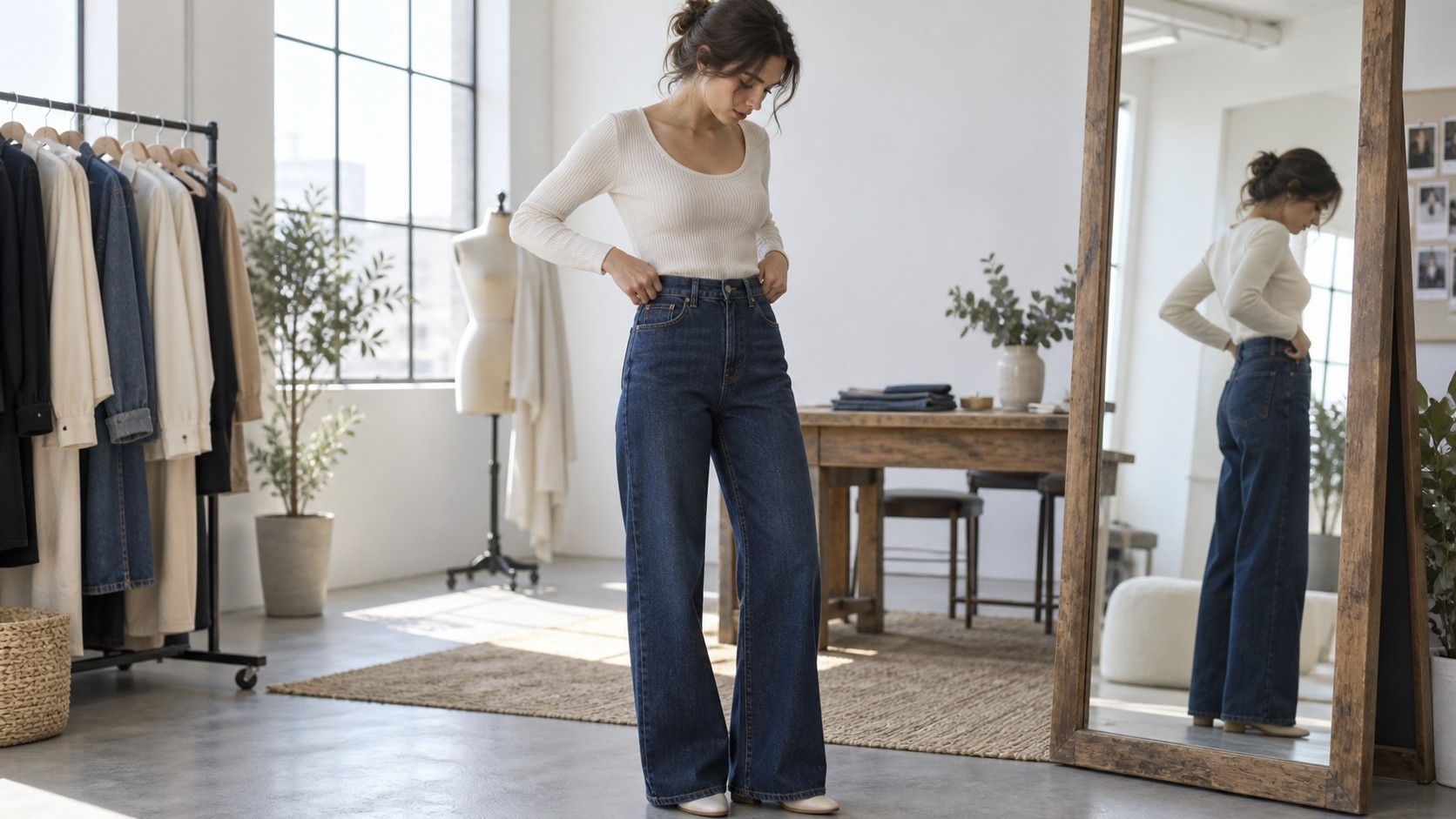
Check the waistband and seat from every angle
Size is a starting point, not a grade. Brand sizing differs, and the same brand may cut a straight leg differently from a wide leg. Bring at least two sizes to the fitting room. It is better to alter a hem or take in a waist than to make peace with a seat that never fits.
Rise is the distance from the crotch seam to the top of the waistband, and it changes both comfort and proportion. A mid-rise is often a reliable everyday choice because it sits between the hip and natural waist. It can work across many body types, especially when you prefer not to feel held in at the ribcage.
High-rise jeans can feel secure and define the waist, which is why they are often useful for a curvier hip-to-waist difference or a longer torso. The important detail is where the waistband lands on your particular body. If it folds when you sit or catches under the bust, the rise may be too high even if the jeans look good while standing.
Low rise is not automatically unflattering or outdated. It can be comfortable on a shorter torso, and it can create a relaxed line with a longer top. The trade-off is coverage and stability: bend, sit and reach before buying. A rise should support the outfit you want to wear, not demand a particular body.
| Jeans feature | Often useful when | Fitting-room check |
|---|---|---|
| Mid-rise | You want a flexible, everyday waist placement | Sit down; the back should remain comfortable and covered |
| High-rise | You like waist definition or want a longer visible leg line | Raise your arms and check for ribcage pressure |
| Straight leg | You want a balanced line through hip, knee and ankle | Look for a clean fall without pulling at the thigh |
| Wide leg | You prefer room through the lower body or a stronger shape | Check that the hem clears the floor in your usual shoes |
| Bootcut | You want a little width to balance the hip or shoulder line | Make sure the flare begins below the knee |
Match leg shape to the outfit, not a body-type commandment
Straight-leg jeans are a practical place to begin because they neither cling tightly nor add much volume. They often work when you have a fuller hip, straighter hip, athletic thigh, or simply want one pair that can handle trainers, loafers and boots. The key is a straight line that starts at the hip, not a pair that is so tight in the thigh that it becomes a skinny jean by accident.
Wide-leg jeans create more room and can make an outfit feel intentional, but their proportion depends on the rise and hem. A high rise with a full-length wide leg can lengthen the lower half. A low rise with a short, wide crop can feel more relaxed and horizontal. Try both with the shoes you expect to wear; a wide hem that drags on the floor quickly loses its appeal.
Bootcut and subtle flare shapes are useful when you like balance around the lower leg. The flare should begin below the knee, leaving the thigh and knee area calm. This can work well with a defined shoulder, a fuller hip, or a longer coat, but it is not limited to any one shape. What matters is that the width looks gradual rather than like an abrupt triangle at the ankle.
A waist gap is one of the most common reasons jeans stay unworn. It often appears when the waist is smaller relative to the hips, but it can also come from a very curved back, a shallow seat, or a waistband cut too straight. Turn sideways and look in a mirror behind you if possible. The front can fit perfectly while the back leaves room for a hand.
Curved waistbands, contoured yokes and styles marked curvy may help, but the label is not a guarantee. A good pair should sit against the lower back without needing a belt to do all the work. If everything else fits beautifully, a tailor can take in the centre-back seam; this is one of the most worthwhile denim alterations when the waistband construction allows it.
Look at the back pockets before dismissing them as decoration. Pockets placed high and closer to the centre can make the seat appear more lifted; very low or widely spaced pockets can visually broaden it. There is no universal right placement, but this is an easy detail to compare in a photo when two pairs otherwise seem similar.
Use wash, seams and length to fine-tune the look
Dark, even washes often read as a single clean shape, while fading and whiskering draw attention to the areas where they sit. If you love a faded pair, check that the whiskers lie where your body naturally bends rather than across the widest part of the hip in an awkward way. Raw or deep indigo denim is versatile, but a lighter wash can feel less formal and more forgiving in warm weather.
Seams are not trivial. A side seam that twists around the leg can make even expensive jeans look poorly cut. The inseam should run straight down the inside of the leg, and the outer seam should not pull toward the front. Walk a few steps and check again; twisting sometimes appears only in motion.
Inseam is often the alteration that changes a nearly-right pair into a dependable one. Full-length jeans should graze the top of the shoe rather than fold into a heap. Cropped jeans tend to look best when the hem lands at a deliberate point, usually near the ankle rather than mid-calf. Bring the footwear you wear most, because a one-inch difference can change the entire line.
Know which alterations are worth the effort
Hemming is straightforward, although jeans with an original distressed hem need a tailor who can preserve the finish. Taking in a waistband is often possible when the gap is at the centre back and the seat otherwise fits well. Small adjustments to the leg width can also work, especially on straight jeans that are only slightly too roomy.
More complicated changes are usually not worth the cost. Moving the rise, rebuilding the crotch curve, or dramatically reshaping the hip changes the architecture of the jeans. If the crotch pulls, the pockets sit in the wrong place, and the waist gaps all at once, it is kinder to leave that pair in the shop.
Fabric composition deserves a look before you commit to alterations. One or two percent elastane can add comfort while keeping a denim look. A very high stretch percentage may be pleasant initially but can relax quickly, especially at the knees and seat. Rigid cotton often molds to the body over several wears, but it should never require pain as a break-in period.
Make the final decision in an outfit you would really wear
Try jeans with a top you own or something close to it. A pair that looks perfect with a tiny fitting-room tank may behave differently with a tucked shirt, a chunky sweater or a blazer. Add the shoes that match your routine, whether that is a trainer, boot, flat or heel. This exposes hem problems and waistband pressure quickly.
Take front, side and back photos under ordinary light. Notice whether you are focused on your outfit or already thinking about how to hide a gap, a pull line or an uncomfortable seam. Comfortable jeans are not boring; they are the ones that let a good shirt, a favourite coat or an interesting shoe have their moment.
Over time, a small rotation is more useful than chasing one perfect universal pair. A straight leg for everyday wear, a relaxed wide leg for softer outfits, and a darker tailored pair for evenings can cover a lot of ground. Choose jeans for your body type as a starting conversation with fit, then let comfort, movement and your own taste make the final call.