Apple body shape outfits work best when they make room for a real day: sitting at a desk, walking to dinner, reaching for a bag, and not adjusting your top every few minutes. The useful question is not how to erase a midsection. It is how a neckline, fabric, waist seam, and trouser line can create an outfit that feels easy and looks deliberate. Once fit stops fighting you, style choices become much more enjoyable.
Read the shape as a proportion, not a problem to solve
An apple shape often carries more visual fullness through the bust, upper waist, or midsection, while the legs and shoulders may be a strong feature. Bodies vary widely within that description. You might have a defined waist from the side but less definition from the front, or a fuller bust that changes how every button-front shirt fits. Rather than comparing yourself with a diagram, notice where garments pull, where they hang cleanly, and where you naturally feel most comfortable.
Make tops useful with neckline and fabric choices
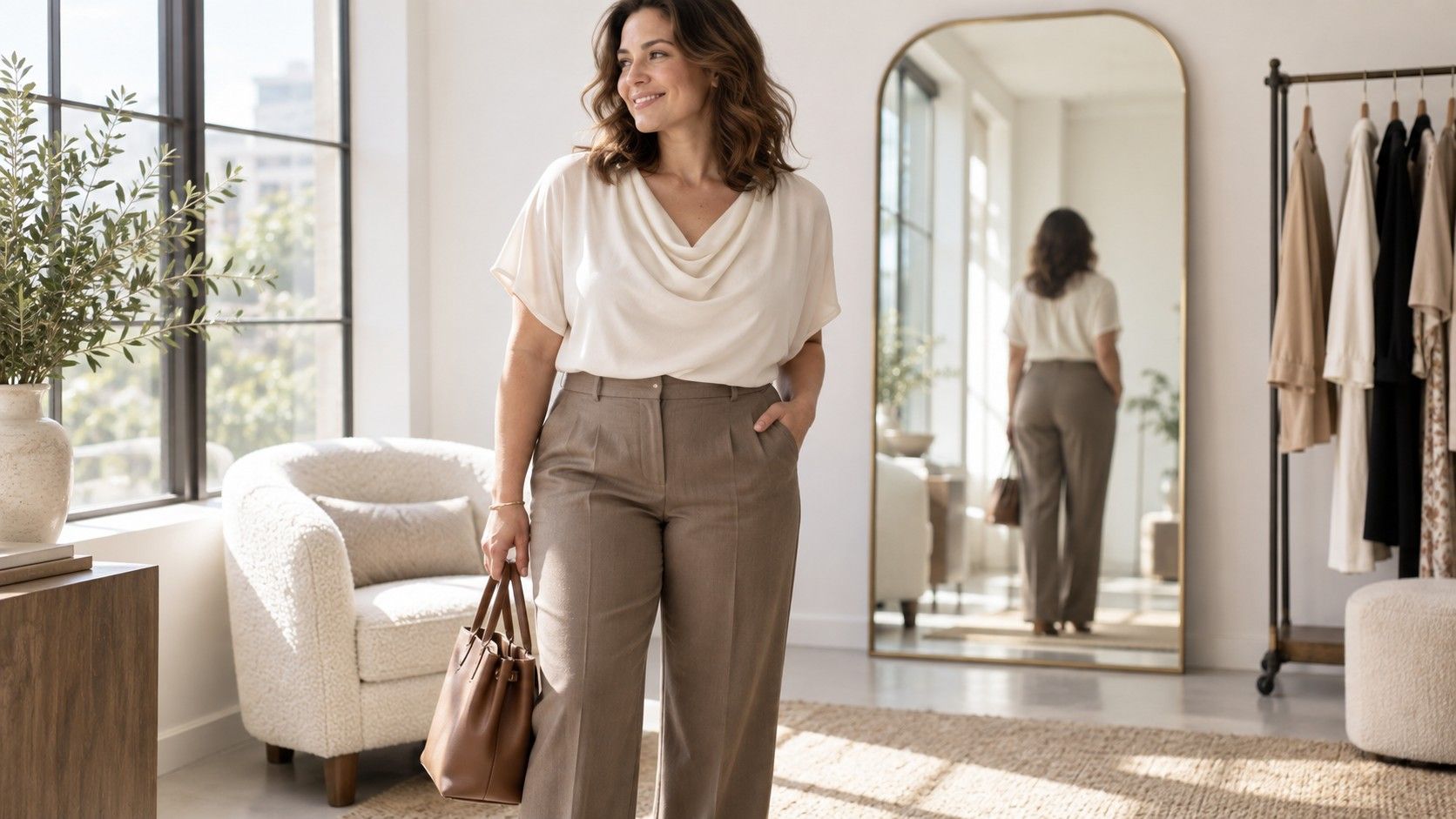
A useful mirror check is to put on simple trousers and a plain top, then look at the overall vertical line from shoulder to ankle. If the top stops at the broadest point and clings there, it may make the outfit feel interrupted. If it skims with a little space and the trouser has a clean leg, the whole look tends to settle. This is why apple shape clothing often benefits from drape and a visible line down the body, rather than from squeezing everything into a made-up waist.
Choose dresses and jumpsuits that leave room to move
Try clothes sitting down as early as possible. A waistband that feels acceptable for thirty seconds can become a nuisance over lunch. A soft woven top that still falls away from the body when seated is usually worth more than a sculpting fabric that only behaves while you are standing under shop lights.
An open neckline is one of the simplest ways to give the upper body breathing room. A V-neck, split neck, soft collar, or unbuttoned shirt neck creates a clear focal point without demanding jewellery or a dramatic print. The opening does not need to be deep. What matters is that the neck of the garment has a little shape rather than ending in a tight horizontal band exactly where you feel fullest.
Fabric drape deserves more attention than size labels. A substantial jersey, crepe, viscose blend, or soft cotton poplin can skim instead of cling, while a very thin rib knit may trace every point you would rather ignore. Hold a top at arm's length before trying it on: if it collapses into a limp tube, it may require a jacket or careful styling. If it keeps a gentle line, it has a better chance of looking polished without being restrictive.
Tunics and long shirts can work, but length is a decision. A hem just below the hip often looks purposeful with slim ankle trousers; a hem that ends at mid-thigh can be more comfortable with leggings or narrow jeans. The least reliable length is one that stops at the fullest point with no structure. Add a half-tuck, a side slit, or an open layer if you love the top but want the outfit to breathe.
For an apple shape, dresses are often at their best when the fabric acknowledges the body without clamping onto it. An empire seam can be lovely if it sits below the bust rather than cutting across it. A shift dress in a weighty fabric works when there is enough ease through the stomach and a neckline that opens the upper chest. Wrap dresses are popular for a reason, but test the wrap point while sitting; some pull open or create too much bulk at the waist.
Column dressing is especially helpful on days you want a simple, uninterrupted silhouette. Think of a dark jersey dress with a long open jacket, or a blouse and trousers in close shades with a brighter shoe. The result is not about looking smaller. It gives the eye a calm route from top to bottom, which can make an outfit feel less busy even when you add colour near the face.
Jumpsuits need a stricter fitting-room test than dresses. Check the torso length by raising your arms and sitting down, then check whether the waist seam stays where it belongs. A jumpsuit that is one inch too short in the body can feel like a punishment by late afternoon. Wide legs and a V-neck are often flattering, but comfort at the rise is the non-negotiable detail.
| Situation | Outfit starting point | Check before leaving home |
|---|---|---|
| Casual day | Open-neck knit, straight jeans, low-profile trainers | The knit does not ride up when you sit |
| Work meeting | Soft blouse, ankle trousers, open blazer | The jacket lies flat when unbuttoned |
| Dinner out | Fluid midi dress, boots, simple earrings | The waist seam stays comfortable after a meal |
| Warm weather | V-neck tee, wide cropped trousers, sandals | The trouser waistband does not roll or pinch |
Use trousers and layers to keep the outfit calm
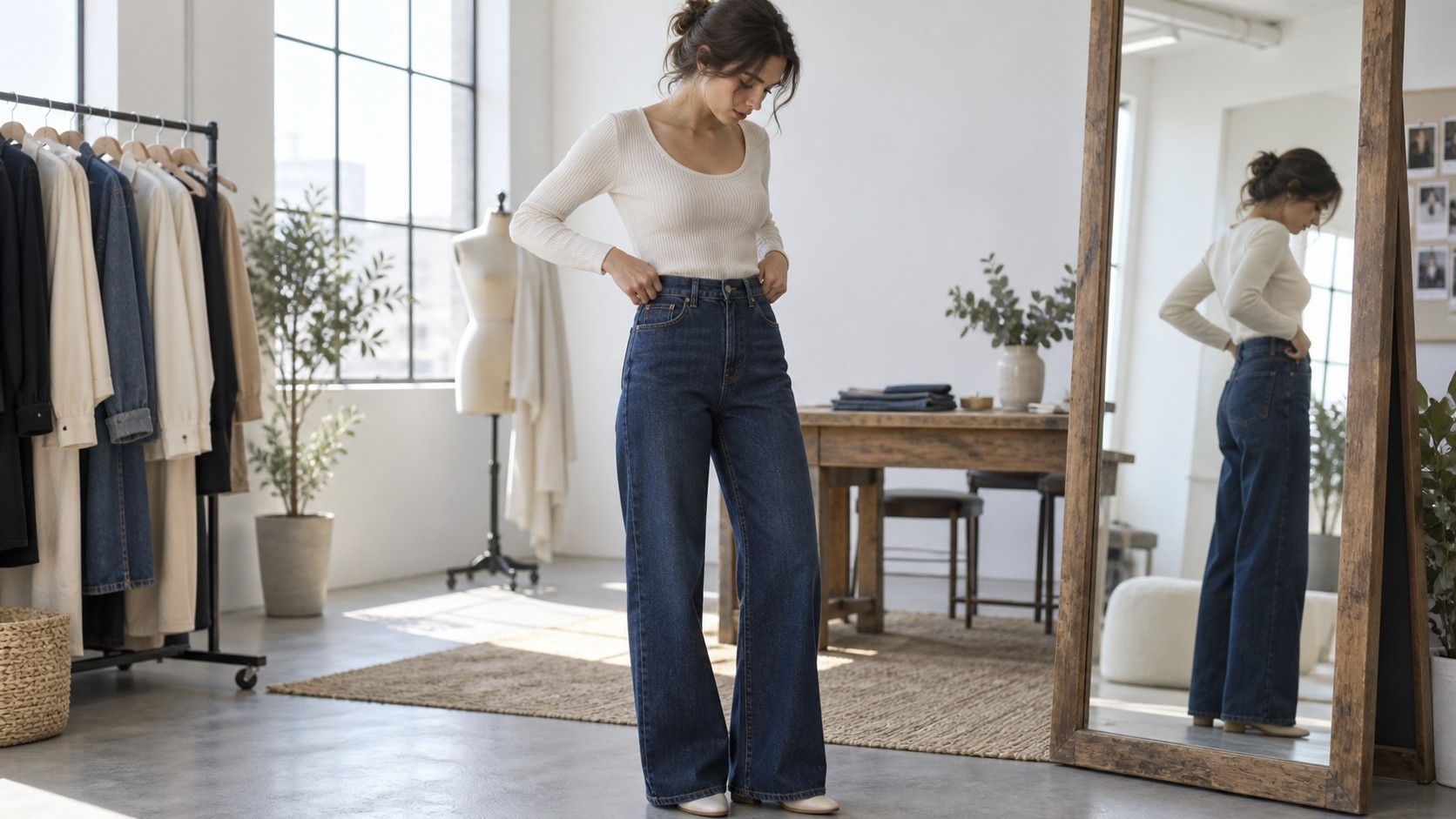
Trousers can be the quiet backbone of apple body shape outfits. Straight, slim-straight, bootcut, and gently wide styles all work when the rise is comfortable and the front stays smooth. A flat front can be useful, but it should not be confused with a rigid front. If the waistband digs in, the fabric above it has nowhere pleasant to go. A slightly stretchy woven trouser often performs better than an ultra-tight shaping style.
Look at pocket placement and ankle length. Front pockets that flare open add fuss where you may not want it; a clean pocketless front or a well-constructed side pocket is easier to wear. Cropped trousers should show the narrowest part of the ankle rather than ending at the widest part of the calf. That small adjustment can make an old pair feel unexpectedly more balanced.
Jacket structure is valuable when it creates vertical lines without becoming armour. An open blazer, long overshirt, or lightweight trench can frame a top and make several familiar pieces feel connected. Choose a layer that has enough shoulder shape to stay in place, then let it hang open. A very tight, buttoned blazer can emphasize every place where the garment is under strain; an overly boxy one can swallow the outfit. There is a comfortable middle ground.
Put comfort ahead of corrective dressing
Advice about how to dress an apple shape sometimes turns into a list of things to hide. That is not a useful wardrobe. If you love a fitted skirt, a sleeveless dress, or a cropped jacket, use it as the expressive part of an outfit and make the surrounding pieces practical. A cropped jacket over a fluid dress can look sharp. A fitted skirt with a relaxed shirt can feel modern. One close-fitting element is often easier to style than an outfit where everything is trying to control the body.
Create a small set of dependable formulas and test them in real life. Photograph one outfit in daylight, wear another for a long afternoon, and notice which items you stop thinking about. Keep notes on rise, sleeve length, and fabrics that make you feel free. The best apple shape clothing is not a prescribed silhouette; it is clothing that lets your legs, face, and personal style show up while the rest of the outfit stays comfortable.
When something does not work, name the specific reason. Maybe the neckline is too closed, the waist seam is too high, or the fabric has no give. That is useful information, and it is much kinder than deciding the whole garment category is wrong for you. Strong proportions come from precise choices, repeated over time, not from dressing according to fear.